KOYO Bearing Insights News & Cases / Industry News
JTEKT False Brinelling Storage Damage Case Wholesale Supplier
- Published
- By Part Number Company, Part Number Company
- Authorized KOYO Distributor
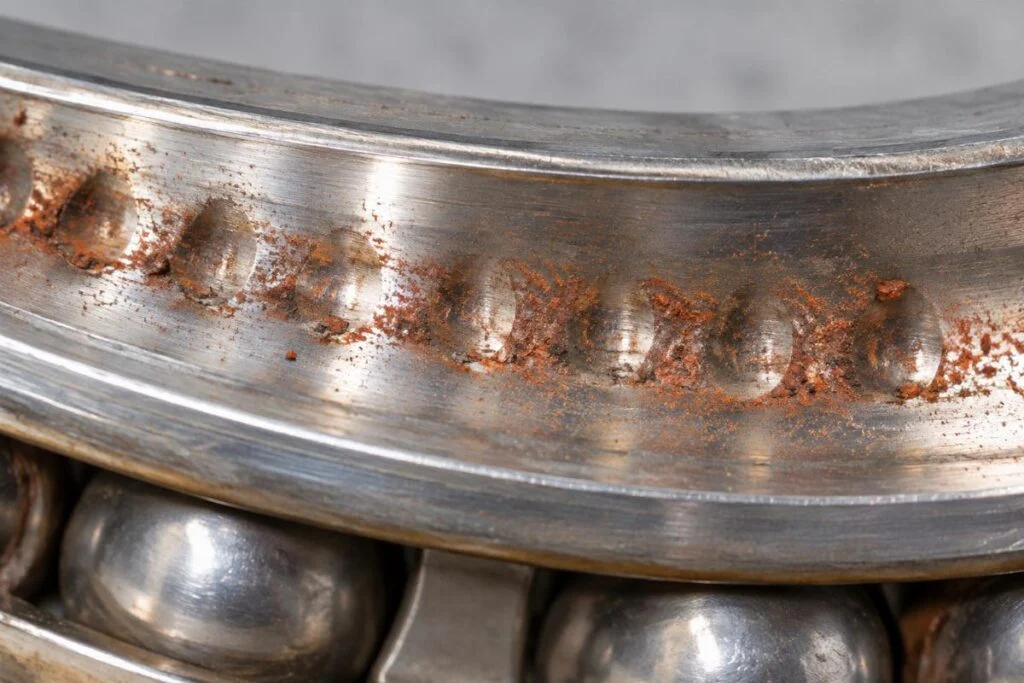
Those raceway dents are not manufacturing defects.
False brinelling in JTEKT bearings is a fretting wear phenomenon caused by vibration during transit and static storage, not a material flaw. It occurs when rolling elements oscillate slightly against the raceway without full rotation, breaking down the lubricant film and causing micro-welding and oxidation. Prevention requires anti-vibration packaging, humidity control, and mandatory periodic shaft rotation.
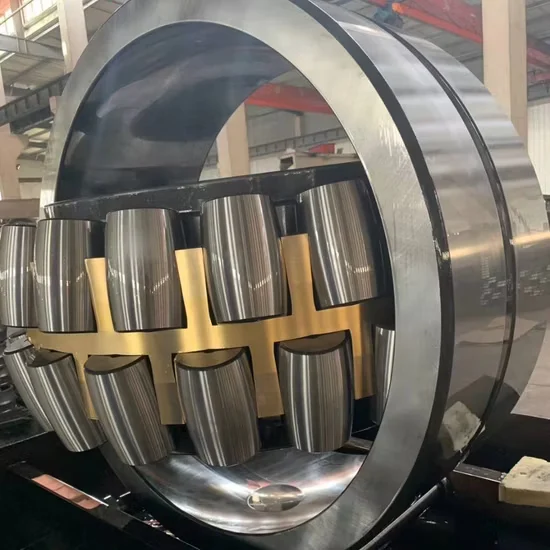
I still remember the silence in the maintenance bay of that Midwest processing plant. The foreman held a disassembled spherical roller bearing, pointing at a series of perfectly spaced, shallow indentations on the inner ring raceway. He was convinced the batch was defective. The steel looked pristine elsewhere, but these marks were undeniable. I ran my finger along the groove. It wasn’t a hard impact mark from overload; it was subtle, accompanied by a fine, reddish-brown powder. This was false brinelling. The bearings had survived the manufacturing quality checks in Japan, only to fail during the four-week sea freight crossing and subsequent months of static storage in a humid warehouse. The vibration from the ship’s engine, combined with the lack of rotation, had caused the rollers to fret against the raceway. This case reshaped how I approach logistics for high-precision components. It is not enough to verify dimensional tolerances; one must protect the bearing from its own inertia during idle periods.
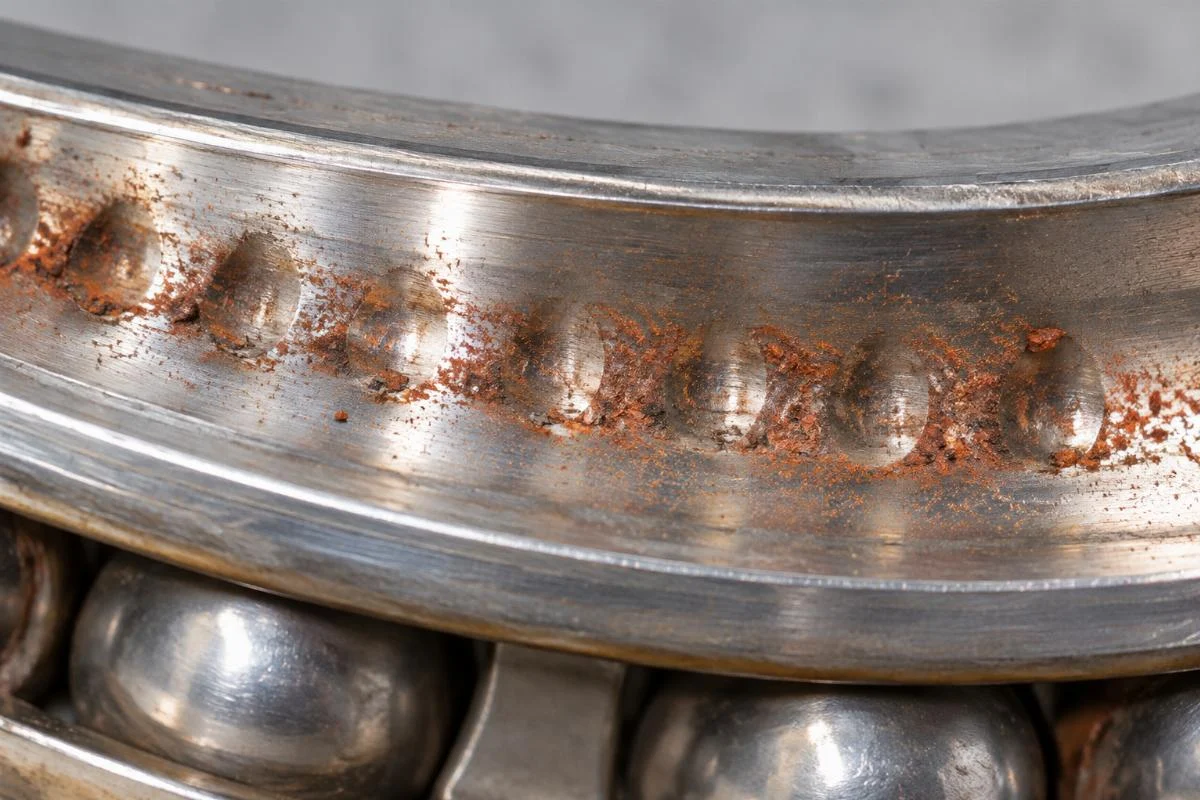
Understanding this failure mode is critical for any JTEKT false brinelling storage damage case wholesale supplier aiming to reduce warranty claims and ensure operational reliability for end-users.
What Exactly is False Brinelling in JTEKT Bearings?
It is a surface fatigue issue driven by micro-motion, not bulk material failure.
True brinelling results from excessive static or dynamic loads that permanently deform the steel beyond its yield strength. False brinelling, conversely, happens under normal or even light loads. When a bearing is stationary but subjected to external vibration, the rolling elements do not roll. Instead, they slide back and forth over a tiny arc of the raceway. This oscillatory motion breaks the protective lubricant film. Without this barrier, metal-to-metal contact occurs at the microscopic level. The resulting friction generates heat and causes local adhesion. As the surfaces separate, tiny particles tear away, oxidize immediately due to exposure to air, and create the characteristic rust-colored debris.
This process is insidious because it mimics other failure modes. To the untrained eye, it looks like poor heat treatment or substandard steel cleanliness. However, the spacing of the marks corresponds exactly to the distance between rolling elements. In a spherical roller bearing, this pattern is distinct. The damage initiates at the molecular level, long before visible pitting appears. For distributors handling JTEKT false brinelling storage damage case wholesale supplier inquiries, distinguishing this from manufacturing defects is the first step in root cause analysis. If the bearing was never rotated after arrival, the likelihood of false brinelling skyrockets, regardless of the initial quality grade.

How Does Transit and Storage Trigger This Damage?
Continuous low-frequency vibrations during shipping and long-term static storage without rotation cause lubricant film breakdown.
The journey from the manufacturer to the end-user is often more dangerous than the operation itself. Consider the transatlantic shipping route. A container sitting on a vessel deck is subject to constant engine vibration and wave-induced shaking. These frequencies, while low amplitude, are persistent. If the bearings are not isolated, this energy transfers directly to the rolling elements. Upon arrival, the scenario often worsens. Warehouses in tropical or humid climates introduce moisture. If the bearings sit on pallets for months without being turned, gravity keeps the same set of rollers in contact with the same spot on the raceway. The weight of the rotor or shaft, even if minimal, provides enough normal force to facilitate fretting when combined with ambient vibration from nearby machinery or traffic.
I once audited a distribution center in Southeast Asia where heavy equipment bearings were stored for nearly half a year. The humidity levels were consistently high, and the storage racks were near a busy loading dock. The forklift traffic created just enough ground vibration to initiate micro-motion in the unrotated bearings. When we inspected the stock, nearly a quarter of the large-bore spherical units showed early signs of false brinelling. The grease had separated, and the base oil had drained away from the contact zone, leaving the thickener unable to protect the steel. This is why a responsible JTEKT false brinelling storage damage case wholesale supplier must enforce strict storage protocols. It is not merely about keeping the box dry; it is about managing kinetic energy and lubricant distribution during idle periods.

What Are the Visible Signs During Teardown?
Look for rule-like indentations on the raceway matching the rolling element spacing, often accompanied by reddish-brown debris.
Identifying false brinelling requires a methodical teardown. The first clue is visual. Clean the bearing thoroughly with a solvent to remove old grease. Inspect the raceways under bright, oblique lighting. You will see a series of shallow, elliptical depressions. Unlike spalling, which has sharp, irregular edges, false brinelling marks are smooth and evenly spaced. The distance between them matches the pitch of the rolling elements.
The second clue is the debris. Scrape the bottom of the housing or the bearing cavity. If you find a fine, rust-colored powder, it is a strong indicator of fretting corrosion. This oxide forms as the micro-welded junctions break and react with oxygen. In advanced stages, the surface may appear matte or dull in the affected zones, contrasting with the shiny, untouched areas.
| Feature | False Brinelling | True Brinelling | Normal Wear |
|---|---|---|---|
| Mark Spacing | Evenly spaced, matching element pitch | Random or clustered at load zone | Uniform circumferential polishing |
| Surface Texture | Smooth, shallow depressions | Sharp-edged, deep plastic deformation | Gradual material loss |
| Debris Color | Reddish-brown oxide powder | Metallic chips or none | Fine metallic particles |
| Cause | Vibration + Static position | Excessive static/dynamic load | Normal operation over time |
| Preventability | High (rotation/packaging) | Low (design/load issue) | N/A |
For a JTEKT false brinelling storage damage case wholesale supplier, providing this diagnostic matrix to clients helps shift the conversation from blame to solution. It empowers maintenance teams to identify the root cause quickly, preventing unnecessary replacement of good stock and focusing on storage improvements.

How Can Distributors Prevent Storage Damage?
Implement strict anti-vibration packaging, control warehouse humidity, and enforce mandatory periodic shaft rotation schedules.
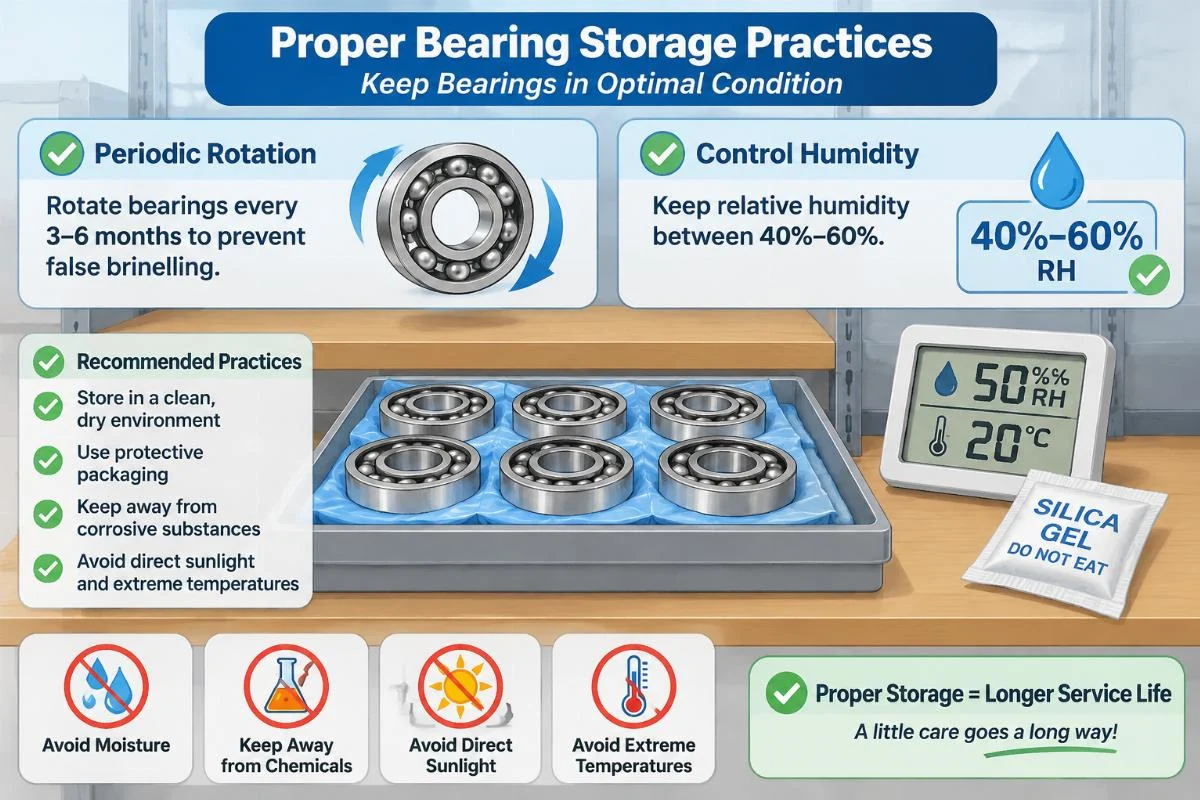
Prevention is entirely logistical and procedural. It starts with packaging. Standard cardboard boxes offer little protection against low-frequency vibration. Bearings intended for long-distance sea freight or extended storage should be packed with anti-vibration dunnage. This material absorbs kinetic energy before it reaches the bearing. Additionally, the choice of preservative grease matters. Standard rust preventives may not have the adhesive properties needed to stay in place during oscillation. High-quality, tacky preservatives resist displacement better.
Once in the warehouse, environmental control is key. Maintain relative humidity below acceptable thresholds to slow oxidation if micro-motion occurs. But the most critical step is rotation. Bearings must not remain static. A simple schedule of rotating the shaft or outer ring by a few revolutions every month redistributes the lubricant and changes the contact point. This prevents the same microscopic area from being subjected to continuous fretting.
I advise all partners to include a storage guideline card with every shipment. It sounds trivial, but it serves as a constant reminder. For large bearings, use lifting gear to rotate the assembly gently. For smaller units, manual rotation suffices. By treating storage as an active phase of the bearing’s life cycle, rather than a passive wait, we eliminate the primary driver of false brinelling. This proactive approach is what defines a premium JTEKT false brinelling storage damage case wholesale supplier. It transforms a potential failure into a non-event, ensuring that when the bearing is finally installed, it performs exactly as engineered.
Conclusion
False brinelling is a preventable logistics failure, not a product defect.
By understanding the mechanics of fretting corrosion and implementing rigorous storage and handling protocols, distributors and end-users can safeguard their inventory. The key lies in recognizing that vibration and static positioning are the enemies, and rotation and proper packaging are the solutions. As a trusted JTEKT false brinelling storage damage case wholesale supplier, we prioritize these details to ensure every bearing arrives ready for service, free from the silent damage of transit and storage.
Target Industries
Industries and equipment where the KOYO products in this article are specified.

Written by the Part Number Company team
Part Number Company is an authorized KOYO distributor supplying JTEKT KOYO bearings, seals, lubrication, tools and condition monitoring parts from North American stock in Greenville, SC, plus KOYO factory orders for rare and custom specifications.
About Part Number Company and our KOYO authorizationProducts in this article
KOYO bearings mentioned above
The KOYO models discussed here are available from Part Number Company, either from Greenville stock or by KOYO factory order.

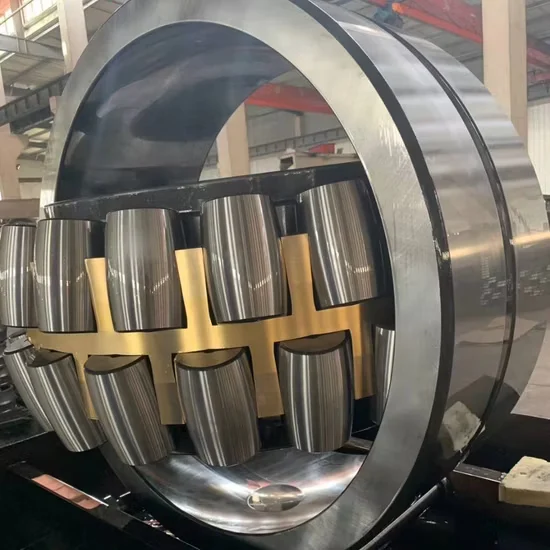
KOYO stock in Greenville, factory orders for the rest
Common KOYO models ship from our North American warehouse; ultra-precision, custom and rare specifications are ordered direct from KOYO, with full export and customs documents.
Check Stock for Your Models- Stock orders dispatched
- 3 working days
- North America warehouse
- Greenville, SC
- Trade terms
- EXW · FOB · CIF · DAP
- Shipping
- Express · Air · Sea
Keep reading
Related KOYO bearing articles

News & Cases / Industry News · · 6 min read
JTEKT Bearing Reuse and Reconditioning Evaluation Criteria Supplier
Accurate JTEKT bearing reconditioning evaluation criteria prevent unnecessary replacement costs and downtime in heavy industries by distinguishing reconditionable surface wear from structural fatigue. Applying…
Read the Article
News & Cases / Industry News · · 8 min read
How to Assess Bearing Market Forecasts Relevant to JTEKT Buyers
Relying on general industry reports for a JTEKT bearing market forecast often leads to stockouts and inflated freight costs due to ignored factory-level bottlenecks.…
Read the Article
News & Cases / Industry News · · 8 min read
JTEKT Bearing Import Risk Reviews: Documentation and Transit Supplier
Navigating JTEKT bearing import risks requires strict customs documentation accuracy and specialized transit packaging to prevent severe port delays. Minor weight discrepancies can trigger…
Read the ArticleRequest a Quote
Send your KOYO model list for a consolidated quote
Part Number Company quotes KOYO bearings, seals, lubrication and tools in one proforma invoice, with multi-currency pricing and the documents your customs and QC teams need.
- JTEKT KOYO authorization letter
- KOYO original quality certificate
- Certificate of origin
- Customs, shipping documents and tracking