KOYO Bearing Insights News & Cases / Industry News
How to Assess Bearing Market Forecasts Relevant to JTEKT Buyers
- Published
- By Part Number Company, Part Number Company
- Authorized KOYO Distributor

Macro growth rates are irrelevant if your specific bearing line is bottlenecked.
Buyers must look beyond macro growth rates and evaluate underlying supply chain capacity, factory lead-time adjustments, and raw material availability to accurately assess JTEKT bearing market forecasts. Relying on general industry reports without checking factory-level allocation shifts leads to stockouts and inflated emergency freight costs.
I still remember the sting of watching a container sit idle in a Ningbo port yard for two months. It was filled with large-size tapered roller bearings destined for a mining project in South America. I had quoted standard FOB lead times based on historical averages, ignoring subtle warnings about capacity reallocation at the KOYO manufacturing facilities in Japan. When demand spiked unexpectedly, my shipment was deprioritized. The resulting demurrage charges and urgent air freight replacements cost a mid-six-figure sum, nearly losing the client. That incident shifted my focus entirely from surface-level market data to the granular realities of production capacity.

Understanding this gap is critical for any procurement professional. While top-line reports might show a healthy global bearing market, they often mask severe shortages in niche, high-load categories. To navigate this, you need to dissect the forecast through the lens of actual supply chain mechanics rather than broad economic indicators.
Why Do Macro Forecasts Fail JTEKT Buyers?
General industry growth metrics ignore specific production bottlenecks in heavy-duty lines.
Most market analysis reports aggregate data across all bearing types, from miniature instrument bearings to massive slewing rings. This aggregation creates a false sense of security. A rising tide does not lift all boats equally when factory floor space is finite. For buyers sourcing JTEKT products, particularly those requiring heavy-load tapered roller bearings or large spherical roller bearings, the macro view is often misleading.
The core issue lies in production line flexibility. A factory can easily ramp up output for standard deep-groove ball bearings, which have high automation levels. However, heavy-duty bearings require specialized grinding and heat treatment processes that cannot be quickly scaled. When automotive demand surges, it often consumes the shared steel processing capacity, leaving less room for industrial heavy-equipment orders.
Consider a case involving a European wind farm operator. They relied on a forecast predicting steady supply for their main shaft bearings. The macro report showed positive growth in the renewable energy sector. However, the specific JTEKT models they needed were produced on a line that also served a booming agricultural machinery sector. When harvest season approached, the agricultural orders took priority due to higher volume contracts. The wind farm operator faced a significant delay, forcing them to source expensive spot inventory at a premium.
This mismatch highlights why generic forecasts fail. They do not account for the internal competition for resources within the manufacturer’s ecosystem. Buyers must identify whether their specific bearing category shares production resources with high-volume, volatile sectors. If it does, the macro forecast is likely to underestimate the risk of delay.

To mitigate this, buyers should segment their forecast analysis by bearing type and application. Do not assume that a positive outlook for the “bearing industry” applies to your specific SKU. Instead, investigate the production dynamics of the specific product family. This requires moving beyond public reports and engaging with suppliers who have visibility into factory allocation trends.
How to Track Real Factory Capacity Adjustments?
Monitor factory allocation shifts rather than relying on historical standard lead times.
Standard lead times are static numbers in a dynamic system. During periods of demand volatility, manufacturers adjust capacity allocation weekly, sometimes daily. Relying on a catalog-stated lead time of eight weeks is dangerous if the factory has recently shifted thirty percent of its capacity to a new strategic partner.
Tracking these adjustments requires looking at indirect indicators. One reliable method is monitoring the availability of cross-brand equivalent models. If multiple major brands show extended lead times for similar specifications, it indicates a sector-wide capacity crunch rather than a single-brand issue. Conversely, if only one brand is delayed, it may signal internal production issues or strategic allocation changes.
A distributor in Southeast Asia once faced a sudden stockout of specific cylindrical roller bearings. Their standard supplier quoted a twelve-week delay, citing high demand. By checking the availability of equivalent models from other premium brands like NSK and SKF, they realized the delay was isolated to the original brand’s factory scheduling. They switched their order to an available equivalent, maintaining their service level to end-users. This strategy relies on having access to a broad portfolio of genuine bearings and the technical expertise to validate equivalency.
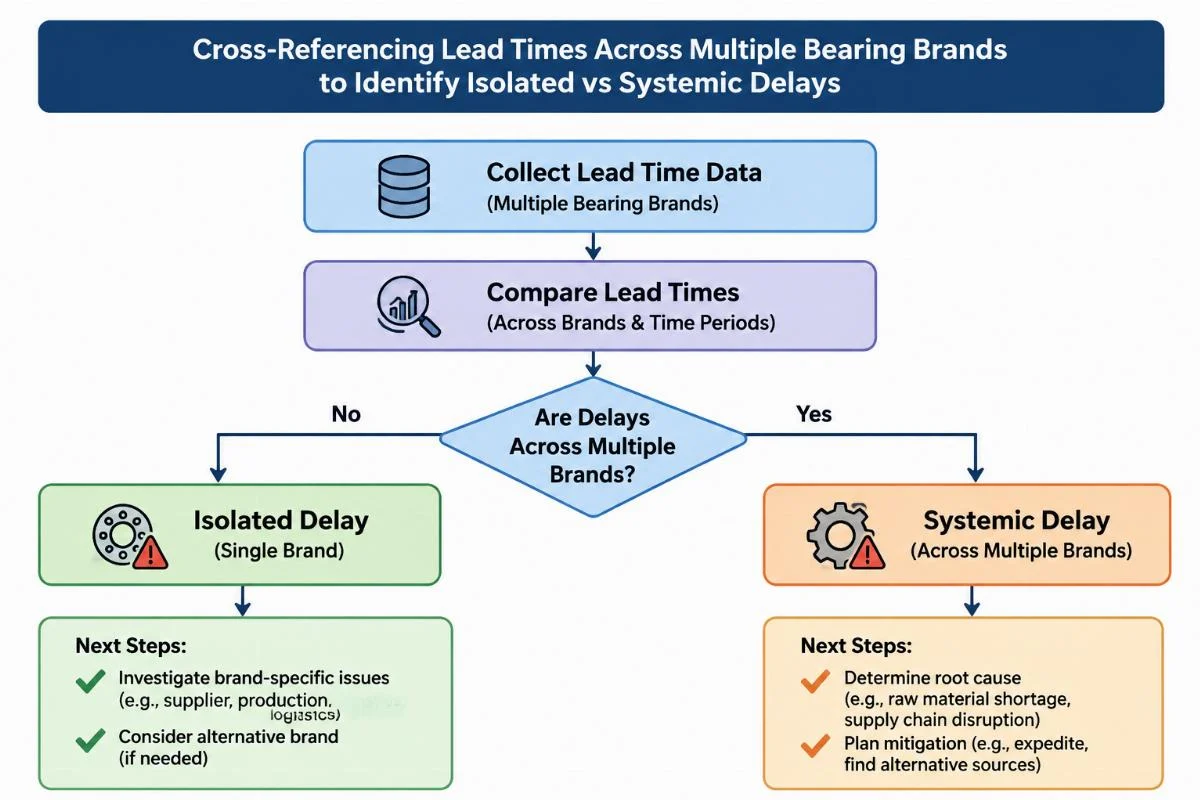
Another indicator is the behavior of spot market prices. When factory capacity is tight, authorized distributors often release limited spot stock. A sudden increase in spot availability at higher prices can signal that the factory is prioritizing direct key accounts, leaving channel partners with reduced allocations. Buyers should interpret these price signals as warnings of underlying capacity constraints.
Engaging with suppliers who maintain massive spot inventories can provide a buffer against these fluctuations. Such suppliers often secure allocations in advance or hold stock against forecasted demand, insulating buyers from immediate factory schedule changes. This approach transforms capacity tracking from a reactive panic to a proactive strategy.
What Supply Chain Metrics Actually Matter?
Focus on raw material availability and global shipping variances, not just price trends.
Price is a lagging indicator. By the time bearing prices rise, the shortage has already occurred. Leading indicators are found further upstream in the supply chain. Raw material availability, specifically high-purity bearing steel, is a critical constraint. Fluctuations in steel production or quality control issues at mill levels can halt bearing manufacturing long before finished goods are affected.
Global shipping lead-time variance is another vital metric. Even if a bearing is ready ex-factory, congestion at key ports or lack of container availability can add weeks to the delivery timeline. For buyers in regions like Latin America or Africa, where shipping routes are less frequent, this variance is magnified. Ignoring shipping logistics in favor of factory lead times results in inaccurate project planning.
Consider a Middle East steel mill that experienced unexpected downtime. They had secured bearings with a confirmed production date, but failed to account for a surge in freight rates and container scarcity during the peak shipping season. The bearings sat in a warehouse in Asia for several weeks while the buyer scrambled for shipping space. The cost of expedited freight far exceeded any savings negotiated on the bearing price itself.
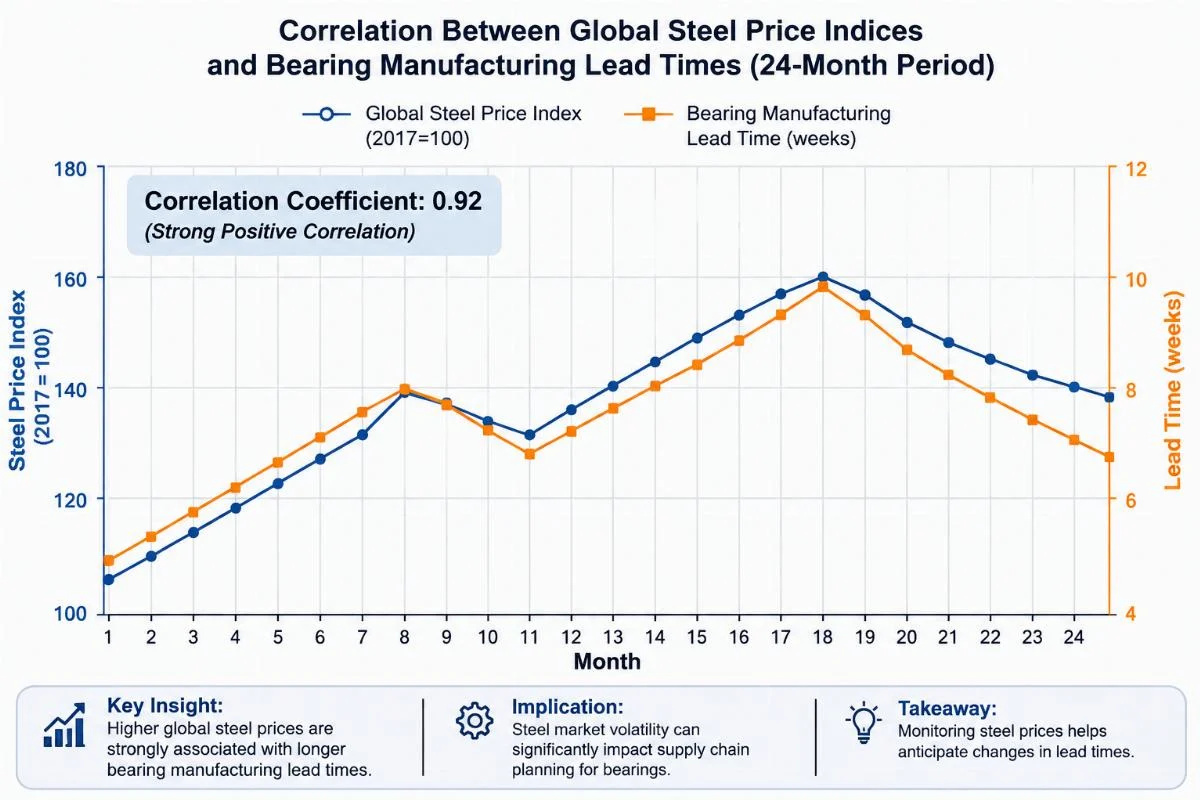
To assess these metrics, buyers should monitor steel price indices and global freight rate benchmarks. A spike in steel prices often precedes a tightening in bearing supply as manufacturers compete for raw materials. Similarly, rising freight rates indicate logistical bottlenecks that will impact delivery reliability.
Integrating these metrics into your procurement dashboard provides a more holistic view of risk. It allows you to anticipate delays before they become critical. Suppliers who offer global shipping consolidation and inspection services can help mitigate these logistical risks, ensuring that once the bearing leaves the factory, it moves efficiently toward its destination.
How to Build a Resilient Procurement Strategy?
Combine genuine spot inventory with cross-brand technical consultation to mitigate risks.
Resilience is not about predicting the future perfectly; it is about having options when predictions fail. A robust procurement strategy for JTEKT bearings involves diversifying sources and maintaining access to genuine spot inventory. This does not mean buying excessive stock, but rather partnering with suppliers who hold substantial inventory of critical SKUs.
Cross-brand technical consultation is equally important. In many applications, a bearing from one premium brand can be replaced by an equivalent from another without compromising performance. Having a supplier who can provide this technical validation allows you to switch sources quickly when one brand faces capacity issues. This flexibility is crucial for MRO operations where downtime costs are prohibitive.
A mining operator in Australia implemented this strategy after facing repeated delays. They established a relationship with a supplier offering a full spectrum of genuine bearings from brands like KOYO, SKF, and TIMKEN. When a specific JTEKT spherical roller bearing became unavailable, the supplier’s engineering team validated an equivalent model from another brand. The replacement was sourced from spot inventory and installed within days, avoiding a costly production stoppage.

Flexible MOQs also contribute to resilience. Being able to order single units for emergency repairs or full containers for project stock allows buyers to adapt to changing needs without being locked into rigid purchasing structures. This agility is essential in volatile markets where demand can shift rapidly.
Ultimately, resilience comes from information and access. Knowing the real status of factory capacity, having visibility into raw material trends, and maintaining relationships with suppliers who offer both technical expertise and physical inventory creates a buffer against market uncertainty. This approach transforms procurement from a transactional function into a strategic advantage.
Conclusion
Stop trusting macro averages and start tracking factory floor realities.
Accurate assessment of JTEKT bearing market forecasts requires digging beneath surface-level growth data. By monitoring factory capacity adjustments, raw material availability, and shipping variances, buyers can anticipate disruptions before they impact operations. Combining this insight with access to genuine spot inventory and cross-brand technical support builds a procurement strategy that withstands market volatility.
Target Industries
Industries and equipment where the KOYO products in this article are specified.

Written by the Part Number Company team
Part Number Company is an authorized KOYO distributor supplying JTEKT KOYO bearings, seals, lubrication, tools and condition monitoring parts from North American stock in Greenville, SC, plus KOYO factory orders for rare and custom specifications.
About Part Number Company and our KOYO authorizationProducts in this article
KOYO bearings mentioned above
The KOYO models discussed here are available from Part Number Company, either from Greenville stock or by KOYO factory order.

Deep Groove Ball Bearings
6203 Deep Groove Ball Bearing for Electric Motors
View Product
Deep Groove Ball Bearings
6006/6206/6306/6406 Deep Groove Ball Bearing
View Product
Deep Groove Ball Bearings
6204 Deep Groove Ball Bearing 20×47×14 mm
View Product
Deep Groove Ball Bearings
6003 Deep Groove Ball Bearing for Fan Equipment
View ProductKOYO stock in Greenville, factory orders for the rest
Common KOYO models ship from our North American warehouse; ultra-precision, custom and rare specifications are ordered direct from KOYO, with full export and customs documents.
Check Stock for Your Models- Stock orders dispatched
- 3 working days
- North America warehouse
- Greenville, SC
- Trade terms
- EXW · FOB · CIF · DAP
- Shipping
- Express · Air · Sea
Keep reading
Related KOYO bearing articles

News & Cases / Industry News · · 6 min read
JTEKT Bearing Reuse and Reconditioning Evaluation Criteria Supplier
Accurate JTEKT bearing reconditioning evaluation criteria prevent unnecessary replacement costs and downtime in heavy industries by distinguishing reconditionable surface wear from structural fatigue. Applying…
Read the Article
News & Cases / Industry News · · 7 min read
JTEKT False Brinelling Storage Damage Case Wholesale Supplier
Discover why raceway dents in False Brinelling JTEKT Bearings are transit-induced fretting wear rather than manufacturing defects. Learn how continuous low-frequency vibrations and long-term…
Read the Article
News & Cases / Industry News · · 8 min read
JTEKT Bearing Import Risk Reviews: Documentation and Transit Supplier
Navigating JTEKT bearing import risks requires strict customs documentation accuracy and specialized transit packaging to prevent severe port delays. Minor weight discrepancies can trigger…
Read the ArticleRequest a Quote
Send your KOYO model list for a consolidated quote
Part Number Company quotes KOYO bearings, seals, lubrication and tools in one proforma invoice, with multi-currency pricing and the documents your customs and QC teams need.
- JTEKT KOYO authorization letter
- KOYO original quality certificate
- Certificate of origin
- Customs, shipping documents and tracking