KOYO Bearing Insights Installation & Maintenance
JTEKT Bearing Mounting: Cleanliness & Tooling Checklist Bulk Supplier
- Published
- By Part Number Company, Part Number Company
- Authorized KOYO Distributor

Visually clean is not clean enough for precision bearings.
Proper JTEKT bearing mounting requires strict adherence to cleanliness protocols and the use of specialized hydraulic or induction tools to prevent premature failure. Relying on manual force or inadequate environmental controls introduces microscopic contaminants and mechanical stress that destroy the lubrication film and fracture hardened steel rings, leading to catastrophic downtime long before the expected service life is reached.
I still remember the silence in a heavy industry crusher plant that should have been roaring with activity. A batch of new spherical roller bearings had failed within days of installation. The maintenance team insisted they were careful, but the wreckage told a different story. The cages were shattered, not from overload, but from abrasive particles embedded in the raceways. Later, I watched another team in a conveyor system workshop use a soft-faced hammer to tap a bearing into place. They thought the gentle taps were safe. They were wrong. The uneven impact created micro-cracks in the inner ring that propagated under load, causing failure within weeks instead of years. These were not isolated incidents. In a paper mill, I saw technicians heat bearings with open flames because they lacked proper induction heaters. The resulting dimensional distortion made mounting a nightmare, tripling the installation time and compromising the fit. These experiences reinforced a single truth: the quality of the bearing is irrelevant if the mounting process is flawed.
Understanding why these failures happen is the first step toward preventing them. The gap between a bearing that lasts for years and one that fails in days often lies in the details of the installation process. This guide breaks down the critical elements of a successful mount, focusing on the non-negotiable standards for cleanliness and tooling.
Why Do JTEKT Bearings Fail Prematurely During Installation?
Most early bearing failures are not due to material defects but to improper mounting techniques.
The assumption that a genuine bearing will perform flawlessly regardless of how it is installed is a dangerous misconception. A significant percentage of premature failures stem directly from the mounting process. When a bearing is forced onto a shaft or into a housing without the correct method, the internal geometry is compromised.
Consider the physics of a press fit. The goal is to create a secure interference fit without damaging the rolling elements or the raceways. Manual methods, such as using a hammer and drift, apply uneven force. This localized stress can cause brinelling—small dents in the raceway—or initiate micro-cracks in the hardened steel. Once a crack starts, it grows with every rotation until the ring fractures.
In contrast, proper mounting distributes force evenly. Hydraulic nuts or presses apply uniform pressure, ensuring the bearing seats correctly without shock loading. Similarly, thermal expansion methods, when controlled precisely, allow the inner ring to expand uniformly, sliding onto the shaft with zero mechanical force. The absence of shock means the integrity of the steel remains intact.
The cost of ignoring this is not just the price of the replacement bearing. It is the lost production time, the labor for emergency repairs, and the potential damage to adjacent components. In high-value applications like mining crushers or wind turbines, the downtime cost dwarfs the component cost. Ensuring the mounting process is correct is an insurance policy against these hidden losses.
What Are the Essential Cleanliness Protocols for Mounting?
Microscopic dust acts as an abrasive that destroys the lubrication film instantly.
Many operators believe that if a workspace looks clean, it is safe for bearing installation. This is a critical error. To the naked eye, a surface may appear spotless, but it can still harbor particles large enough to damage the precision surfaces of a bearing. These particles act as grinding agents, scoring the raceways and rollers as soon as the bearing begins to rotate.
The environment must be controlled. Ideally, bearing mounting should take place in a dedicated area separated from general machining or grinding operations. If this is not possible, the immediate work zone must be isolated. Use plastic sheeting to cover nearby machinery and prevent airborne dust from settling on the components.
Handling is equally important. Bearings should remain in their original packaging until the moment of installation. Hands must be clean and dry, or preferably, technicians should wear lint-free gloves. Skin oils and sweat are corrosive and can lead to rust formation on highly polished surfaces. Even a single fingerprint can become a initiation point for corrosion if the bearing is stored for any length of time after mounting.
Tools must also be clean. Drifts, hammers, and hydraulic equipment should be wiped down with a solvent that leaves no residue before use. Any contaminant introduced during the mounting process becomes trapped inside the bearing, where it cannot be flushed out by standard lubrication practices.
Adhering to these protocols is not about being overly cautious; it is about respecting the precision engineering of the component. A JTEKT bearing is manufactured to micron-level tolerances. Introducing even a small particle violates those tolerances and guarantees a reduction in service life.
Which Specialized Tooling is Mandatory for JTEKT Bearings?
Hydraulic and induction tools ensure uniform force and thermal expansion, eliminating mechanical shock.
Using the right tools is not a luxury; it is a requirement for reliable performance. For smaller bearings, a mechanical press may suffice, but for larger industrial units, especially spherical roller bearings, specialized tooling is mandatory.
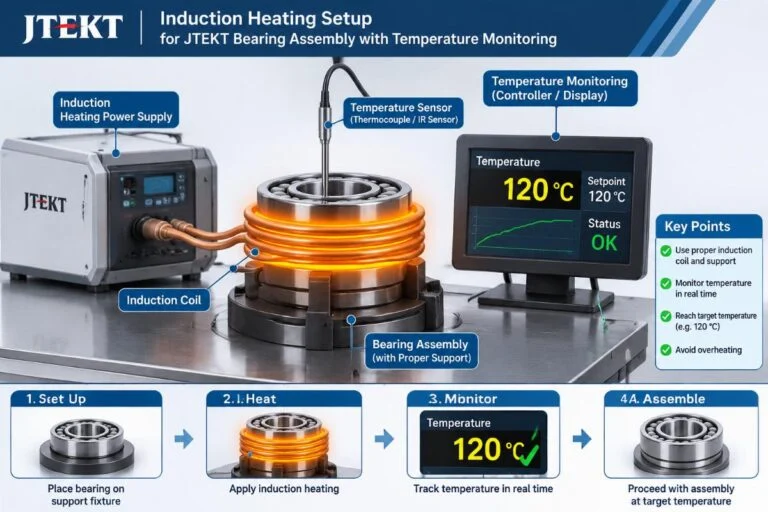
Induction heaters are the preferred method for mounting bearings with tight interference fits. They heat the inner ring quickly and uniformly, causing it to expand. The key parameter is temperature control. The heating must be regulated to ensure the temperature does not exceed the maximum limit specified by the manufacturer, typically around 120°C for standard bearings. Exceeding this temperature can alter the metallurgical structure of the steel, reducing its hardness and load-carrying capacity.
For withdrawal sleeves or large cylindrical bearings, hydraulic nuts are essential. These devices generate the immense axial force required to drive the bearing onto a tapered seat. The pressure must be calculated based on the specific dimensions and fit requirements. Guessing the pressure or using a manual pump without a gauge leads to under-tightening or over-tightening, both of which are detrimental.
| Tool Type | Application | Key Benefit | Risk of Improper Use |
|---|---|---|---|
| Induction Heater | Inner ring expansion | Uniform heating, no mechanical force | Overheating alters steel structure |
| Hydraulic Nut | Tapered seat mounting | Precise axial force control | Incorrect pressure causes fit issues |
| Mechanical Press | Small bearing mounting | Controlled linear force | Misalignment causes raceway damage |
| Soft-faced Hammer | Minor adjustments only | Low impact force | Uneven force causes micro-cracks |
Relying on improvised tools like torches or hammers is a false economy. The time saved during installation is lost many times over in premature failures. Investing in proper tooling protects the investment in the bearings themselves. As a supplier, we often see customers who purchase premium bearings but fail to invest in the tools needed to install them correctly. This mismatch undermines the entire value proposition of the high-quality component.
How to Verify a Successful Bearing Mount?
Post-installation checks like clearance measurement confirm proper fit and alignment.
Mounting the bearing is not the end of the process. Verification is crucial to ensure that the installation was successful. The primary check is the residual radial clearance. For spherical roller bearings mounted on tapered seats, the reduction in clearance indicates how far the bearing has been driven up the taper. This measurement must match the calculated target value. If the clearance is too small, the bearing will run hot and fail quickly. If it is too large, the bearing may slip on the shaft, causing fretting corrosion.
Axial position is another critical parameter. The bearing must be seated firmly against the shoulder of the shaft or the locking device. Any gap indicates incomplete mounting, which can lead to movement under load. Visual inspection should also be conducted to ensure that seals are not damaged and that the housing is properly aligned.
Rotation should be smooth and free of binding. Any roughness or noise suggests contamination or misalignment. In some cases, vibration analysis immediately after startup can detect subtle issues that are not apparent to the touch.
These verification steps provide confidence that the bearing is ready for service. They transform the installation from a hopeful act into a verified procedure. Skipping these checks leaves the operation vulnerable to unknown defects that will manifest as failures later.
Conclusion
Proper mounting is the foundation of bearing reliability.
The longevity of a JTEKT bearing depends less on its inherent quality and more on how it is installed. Strict cleanliness prevents abrasive damage, while specialized tooling ensures that the bearing is seated without mechanical stress. Verifying the fit confirms that the installation meets technical specifications. By treating the mounting process with the same rigor as the selection process, operators can maximize the return on their investment and minimize unplanned downtime.
Target Industries
Industries and equipment where the KOYO products in this article are specified.

Written by the Part Number Company team
Part Number Company is an authorized KOYO distributor supplying JTEKT KOYO bearings, seals, lubrication, tools and condition monitoring parts from North American stock in Greenville, SC, plus KOYO factory orders for rare and custom specifications.
About Part Number Company and our KOYO authorizationProducts in this article
KOYO bearings mentioned above
The KOYO models discussed here are available from Part Number Company, either from Greenville stock or by KOYO factory order.
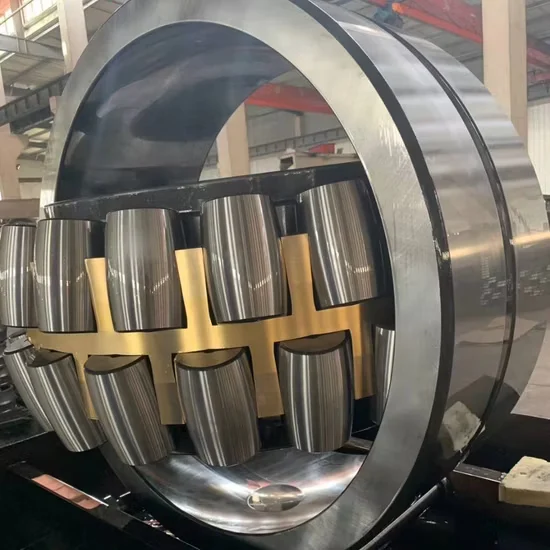
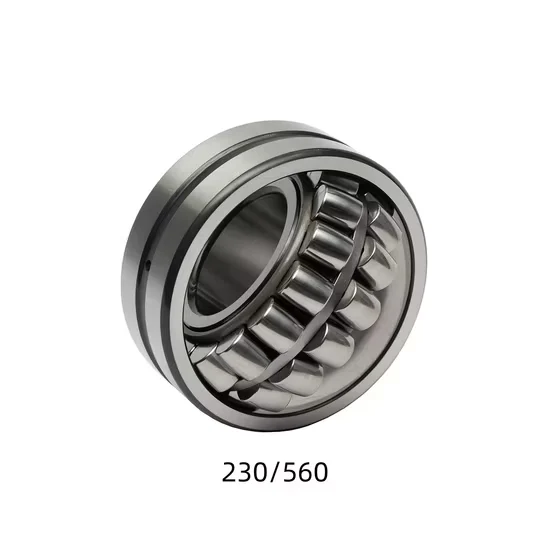
KOYO stock in Greenville, factory orders for the rest
Common KOYO models ship from our North American warehouse; ultra-precision, custom and rare specifications are ordered direct from KOYO, with full export and customs documents.
Check Stock for Your Models- Stock orders dispatched
- 3 working days
- North America warehouse
- Greenville, SC
- Trade terms
- EXW · FOB · CIF · DAP
- Shipping
- Express · Air · Sea
Keep reading
Related KOYO bearing articles
Installation & Maintenance · · 8 min read
Wholesale JTEKT Bearing Assemblies: Temperature, Noise and Vibration
Properly handling the commissioning JTEKT bearing assemblies process prevents premature seizure caused by installation errors rather than manufacturing defects. Controlling initial run-in temperature, identifying…
Read the Article
Installation & Maintenance · · 7 min read
JTEKT Bearings for Standby Equipment Vibration Control Bulk Supplier
Master JTEKT bearings vibration damage control by correcting installation clearance and enforcing strict humidity control to eliminate startup spikes caused by micro-deformation. Discover proven…
Read the Article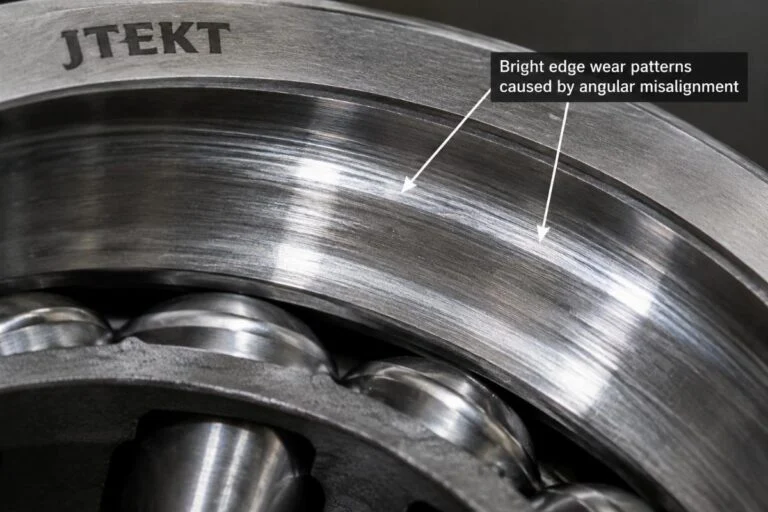
Installation & Maintenance · · 6 min read
Wholesale JTEKT Bearing Assemblies: Misalignment-Induced Loads
Execute precise JTEKT bearing misalignment diagnosis to prevent premature failures caused by sub-millimeter base unevenness and shaft deviation. Discover step-by-step installation checks for soft…
Read the ArticleRequest a Quote
Send your KOYO model list for a consolidated quote
Part Number Company quotes KOYO bearings, seals, lubrication and tools in one proforma invoice, with multi-currency pricing and the documents your customs and QC teams need.
- JTEKT KOYO authorization letter
- KOYO original quality certificate
- Certificate of origin
- Customs, shipping documents and tracking